Will My Property Taxes Go Up When I Buy a House in Bucks County?
Bucks Co. & Beyond Daily
Bucks Co. & Beyond Daily
by Nick Rau
Almost every buyer I work with asks some version of the same question at the kitchen table, usually right after they fall for a house: "Once we buy it, does the tax bill jump?" In Bucks County, the short answer is no, at least not because of the sale. The county hasn't done a countywide reassessment since 1972 and doesn't reassess a home when it sells, so the tax bill the seller pays today is a good preview of the bill you'll pay next year, give or take whatever rate changes your school district, township and the county vote on.
That's genuinely good news, and it surprises people who are moving here from places that reset taxes at the sale price. It also means the question to ask isn't "what's the house worth?" but "what's the assessment, and what are the rates?" Here's how that works, the one tax a sale does trigger, and two pieces of paperwork that are easy to miss after closing.
Bucks County uses what's called a base-year system. Your assessment is roughly what the property would have been valued at under 1972 standards, which is why, as Bensalem Weekly explained this month, a house worth about $400,000 today can carry an assessment of around $23,000. The county changes an assessment mainly when you build an addition or make certain improvements, and its assessors physically look at new construction and additions to keep property records up to date. A rising market, a bidding war or a record sale price on your street doesn't touch it.
So your bill comes down to simple math: your assessment times the combined tax rate, divided by 1,000. One mill is $1 of tax for every $1,000 of assessed value. For 2026 (county and municipal) and 2026/27 (school), the county's own millage sheet shows combined rates (county, municipal and school) ranging from about 159 mills in Bridgeton Township to about 347 mills in Morrisville Borough, and the county's own share is 29.65 mills. Assessments vary by town too, which is why it pays to look up the actual parcel instead of comparing rates alone.
By the numbers: a Bensalem home at the district's median homestead assessment of $23,200 owes about $5,605 a year at current rates before the homestead exclusion, or about $5,268 after it, and roughly 78% of the full bill goes to the school district. (Bensalem Weekly; 2026 county and township and 2026/27 school millage.)
If the sale doesn't move your bill, what does? Rate votes. Your tax is really three taxes set by three separate bodies, and each one votes on its own calendar. School boards adopt a final budget by June 30, which is why school bills typically land in summer (in Bensalem, the bill arrives July 1). The county commissioners set the county rate when they adopt the budget, typically in December; they voted 2-1 on Dec. 17, 2025, to raise it from 27.45 to 29.65 mills. Townships and boroughs set theirs in their own year-end budgets.
The upside is that every increase is a public vote with a public comment period, so nothing sneaks up on you if you know when to look. And if you add a big addition or finish new space that triggers a new assessment, that's a change you chose. One less common exception: Pennsylvania law lets a school district or municipality appeal any assessment in its borders, and in 2023 the state Supreme Court allowed a school district to pick recently sold, underassessed properties for those appeals. That case involved a $54 million apartment complex, not a house, but it's why the honest answer is 'not because of the sale,' not 'never.' If your lender escrows your taxes, expect the monthly payment to adjust after a rate change, which is normal and not a sign anything went wrong.
Buying does come with a one-time tax at settlement: Pennsylvania's realty transfer tax. In Bucks County it's 2% of the value being conveyed, with 1% going to the state and 1% split between the municipality and school district, and it's paid when the deed is recorded (some family transfers, such as between spouses, parents and children, or siblings, are exempt). The county's Recorder of Deeds notes that state and local law don't say who pays it; in most sale agreements, the buyer and seller divide it, though the new owner is on the hook if there's any question about the amount. The value used isn't always the exact sale price, so your title company will confirm the figure on your settlement statement.
The first is new this year. Pennsylvania's Act 29 of 2026, in effect since Sept. 18, 2026, requires buyers who won't live in the property, such as landlords, investors and LLCs, to give the county contact information within 30 days of buying. The law exempts owner-occupied homes, but the Bucks County Board of Assessment's owner contact form is addressed to every buyer who records a deed, and if you'll live in the home it's quick: you check that the property is owner-occupied, sign and return it. Non-occupant owners fill out the longer sections, and the form warns that knowingly giving false information can bring a fine of up to $500.
The second is the one that actually saves you money: the homestead exclusion, which lowers the school tax on your primary residence. You have to apply with the county, and the current application covers the tax year that starts July 1, 2027, with a deadline of March 1, 2027. The form also says that any newly recorded deed, including a refinance, requires a new application within 45 days of filing, so don't assume the seller's exclusion carries over to you. In Bensalem, Bensalem Weekly puts the savings at about $337 a year.
Before you write an offer, I'd pull the parcel's current tax bill and assessment, then ask whether the seller has a homestead exclusion baked into that number, because your first bill may differ until you file your own. I'd also check the school district's last few budget votes, since that's where most of the bill lives. The most common mistake I see is buyers comparing two homes by price alone when their assessments, and therefore their taxes, are thousands of dollars apart. The second is skipping the homestead form in the excitement of moving in. If you think an assessment is simply wrong, the county has an annual appeal window (2026's closed Aug. 3, with changes taking effect for the 2027 tax year), and a real estate attorney or tax professional can tell you if it's worth pursuing. Rules can change, so confirm anything tax-related with the Bucks County Board of Assessment (215-348-6219) or a tax pro or attorney before you rely on it.
Do property taxes go up when you buy a house in Bucks County, PA? Not because of the sale. Bucks County hasn't done a countywide reassessment since 1972 and doesn't reassess a home when it sells, so for most buyers the bill changes when the school district, municipality or county raises its rate, or when improvements change the assessment. Pennsylvania law also lets a school district or town appeal an assessment it thinks is too low, so a sale isn't a guarantee, just not a trigger.
How do I calculate property taxes on a house in Bucks County? Multiply the parcel's assessed value by the combined millage rate (county, municipal and school) and divide by 1,000. The county publishes each year's rates; for 2026 (county and municipal) and 2026/27 (school), combined rates run from about 159 to about 347 mills depending on the municipality and school district.
Who pays the transfer tax in Bucks County, the buyer or the seller? The transfer tax is 2% (1% state, 1% local). State and local law don't say who pays, but in most Bucks County sale agreements the buyer and seller split it. Your agreement of sale controls, so read that section carefully.
When is the Bucks County homestead exclusion deadline? For the tax year starting July 1, 2027, the application is due March 1, 2027. New owners, and anyone who records a new deed or refinances, need to file their own application within 45 days of the new deed.
Comparing towns before you buy? Start with my Bucks County town guides, where each town page links its own local details.
A Bucks County tax bill is one of the more predictable costs of owning a home here, and once you know how it's built, it's easy to plan around. I'm Nick Rau, President of Sales with the Rarity Real Estate Team, ranked in the Top 1% of agents nationally (RealTrends 2025, individual), with more than 135 Google reviews, and I live right here in Bucks County.
Rarity Real Estate Team, 1100 N Delaware Ave Suite A, Philadelphia, PA 19125 · (215) 593-7498 · [email protected]
Want help sizing up the taxes on a Bucks County home before you make an offer? Call (215) 593-7498 or email [email protected].
Blog · Google · Zillow · Instagram @nickraure · Facebook · LinkedIn · X · Threads
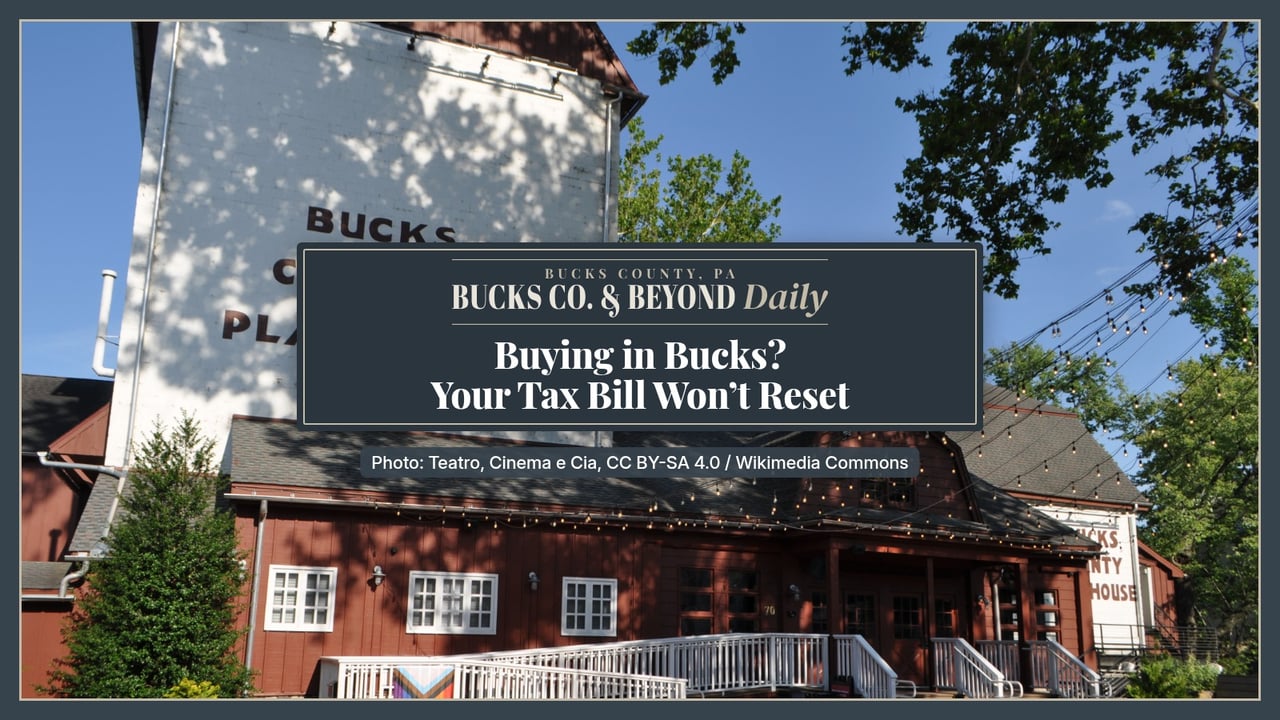
The Bucks County Playhouse by the Delaware River in New Hope, June 2024. Photo (cropped): Teatro, Cinema e Cia, CC BY-SA 4.0 (license), via Wikimedia Commons (source).
Sources: Bucks County Board of Assessment Appeals (homestead deadline, Act 29 filing, assessors, appeal deadline); Bucks County 2026 Millage Rates, updated July 1, 2026; Bucks County Act 29 Owner Information Form; PA Act 29 of 2026, 68 Pa.C.S. Ch. 25 (§ 2504, owner-occupant exemption); 53 Pa.C.S. Ch. 88 (§ 8843, § 8855, taxing-district appeals); GM Berkshire Hills v. Berks County Board of Assessment, Pa. Supreme Court, 2023; Bucks County 2027 Homestead/Farmstead Application; Bucks County Recorder of Deeds, Transfer Tax; Bensalem Weekly, “Your Bensalem Tax Bill Has Three Bosses” (October 2026); Suburban Realtors Alliance, citing the Bucks County Courier Times (September 2025). All checked Oct. 17, 2026.
Want an agent who'll really listen to what you want in a home? Need an agent who knows how to effectively market your home so it sells? Give me a call! I'm eager to help and would love to talk to you.
