Should I Sell My Bucks County House or Rent It Out When I Move?
Bucks Co. & Beyond Daily
Bucks Co. & Beyond Daily
by Nick Rau
Moving out creates two decisions: whether the rental budget works and whether a later sale could qualify for the federal home-sale gain exclusion. Compare the proceeds you would receive from selling with the costs and responsibilities of renting. Depending on your ownership and residence history, some sellers may retain eligibility for roughly three years after moving out, but that is not an automatic tax-free rental period. Ask a CPA to check your dates and circumstances.
Here's how I'd think it through for a Bucks County home as of Nov. 7, 2026, with the local rules in Langhorne, Middletown and Lower Makefield, the Philadelphia side of the line, and the federal tax rule that decides the timing. Every rule below links to the township, city, state or IRS page I checked today. This isn't tax or legal advice, so run your own numbers past a CPA before you decide.
Freddie Mac's national 30-year fixed average fell for a third straight week to 7.18% on Nov. 5, 2026, from 7.24% the week before, according to its Primary Mortgage Market Survey. A year earlier it averaged 6.22%. This is a national survey average, not an individual loan quote. An existing lower-rate mortgage may reduce the cost of keeping the property; selling releases equity after loan payoff, selling costs and any taxes. Compare both budgets rather than treating the rate as an asset you retain after selling.
Under IRS Publication 523, eligible sellers may exclude up to $250,000 of home-sale gain, or up to $500,000 for qualifying married taxpayers filing jointly. The general tests require ownership and use as a main home for at least two years during the five years ending on the sale date, plus the look-back requirement: generally no exclusion on another home sale within the preceding two years. For the joint $500,000 limit, at least one spouse must satisfy ownership, both must satisfy residence, and both must satisfy the look-back requirement. The residence periods need not be continuous. For someone who used the home continuously as a main home immediately before moving out, a sale within roughly three years may still meet the residence test, depending on exact dates. This is not a new three-year entitlement. The nonqualified-use exception covers the portion of the five-year period after the last main-home use; earlier rental use after 2008 can affect the excludable gain. Special rules and partial exclusions may apply. Have a CPA review the full history before relying on an exclusion.
The home-sale exclusion does not shelter gain attributable to depreciation allowed or allowable after May 6, 1997. Rental depreciation can reduce basis, and the related gain may remain taxable even when other gain qualifies for exclusion; ask a CPA to calculate the treatment and applicable rates. Selling after roughly three years away can also fail the general residence test, although special rules may change the outcome. Pennsylvania separately taxes taxable net rental income at its 3.07% personal income tax rate, per the PA Department of Revenue. Federal and Pennsylvania treatment are not identical; obtain individual tax advice.
Rental rules change at municipal boundaries. A Langhorne mailing address is not enough to identify the governing municipality; check the parcel's jurisdiction before applying the rules below.
Across the line, Philadelphia treats renting as a business. You'll need a Rental License ($69 per unit, renewed every year), and if you don't live in the property, a Commercial Activity License and a Business Income & Receipts Tax account, plus a Certificate of Rental Suitability issued within 60 days before the lease starts for each new tenant and lead-free or lead-safe certification for properties built before March 1978, per the city's long-term rental guide. If you do decide to sell instead, my guide to township resale requirements covers the paperwork on that side.
Estimate realistic rent, then account for vacancy and nonpayment, routine maintenance, major replacements and capital reserves, management and leasing fees, property taxes, rental insurance, mortgage principal and interest, HOA or condominium charges, owner-paid utilities and municipal compliance costs. Avoid double-counting taxes and insurance already in escrow. Use property-specific estimates rather than assuming a 10% allowance covers every risk. Compare the result with net sale proceeds, your next-home funding needs and your capacity to manage the property. A positive estimate does not guarantee cash flow, and a thin estimate does not by itself establish that selling is better.
Before offering the home for rent, confirm the municipal registration and inspection schedule, ask your insurer or insurance agent what coverage is appropriate for rental use, and review your loan's occupancy terms with your lender or servicer. Check HOA or condominium documents for rental restrictions. Do not assume every mortgage or insurance policy has identical requirements. If you are comparing sale timing, the fall vs. spring selling post provides additional context.
Can I rent out my house and still avoid capital gains tax when I sell?
Possibly, but renting before selling is not automatically tax-free. IRS Publication 523 requires ownership, residence and look-back tests, with additional requirements for the joint $500,000 limit. A sale within roughly three years after moving out may satisfy the residence test for an owner who previously lived there continuously, depending on dates. Depreciation-related gain and some earlier nonqualified use may remain taxable. Ask a CPA to calculate your eligibility and taxable gain before deciding when to sell.
Do I need a rental license in Bucks County?
It depends on the municipality. Langhorne Borough requires rental registration and a Use and Occupancy inspection for each new tenant, Middletown Township requires a Certificate of Approval before a new tenant moves in, and Lower Makefield requires an annual occupancy report by Feb. 1. Check your township's website before you list it for rent.
How much does a Philadelphia rental license cost?
$69 per unit, renewed every year, per the City of Philadelphia. Owners who don't live in the property also need a Commercial Activity License and a Business Income & Receipts Tax account.
Is rental income taxed in Pennsylvania?
Yes. Pennsylvania taxes net income from rents at its flat 3.07% personal income tax rate, as a separate class of income, on top of federal tax.
For local context, explore Langhorne and Lower Makefield, request a home valuation, or browse my Bucks County neighborhoods guide.
Selling or renting starts with two checks: a complete rental budget and a CPA's review of your home-sale exclusion eligibility. I'm Nick Rau, President of Sales with the Rarity Real Estate Team, ranked in the Top 1% of agents nationally (RealTrends 2025, individual), with more than 135 Google reviews, and I live right here in Bucks County.
Rarity Real Estate Team, 1100 N Delaware Ave Suite A, Philadelphia, PA 19125 · (215) 593-7498 · [email protected]
Questions about selling or renting your Bucks County home? Call (215) 593-7498 or email [email protected].
Blog · Google · Zillow · Instagram @nickraure · Facebook · LinkedIn · X · Threads
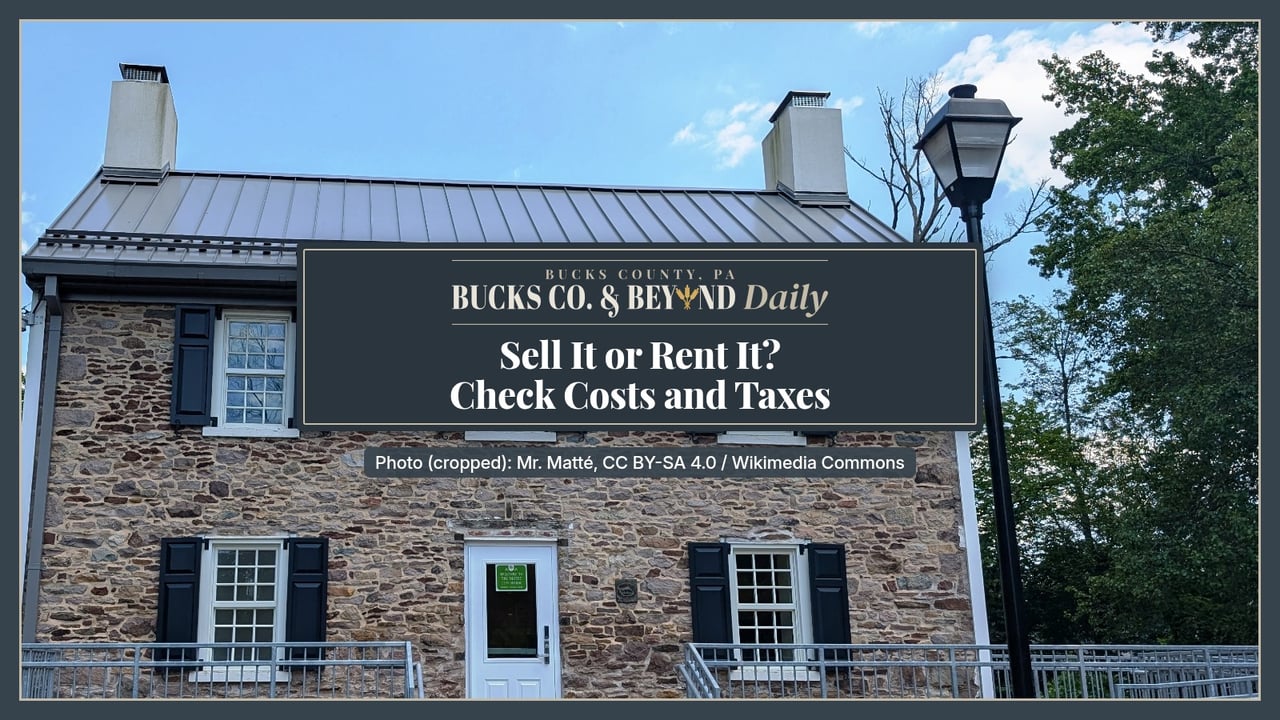
Featured image: the 1799 House in Lower Makefield Township, a former private home now a public trailhead and restroom building operated by the DRJTBC. June 2025 file photo used as illustrative local context, not a property being marketed for rent. Photo (cropped): Mr. Matté, CC BY-SA 4.0 / Wikimedia Commons. Cropped photo adaptations are licensed under CC BY-SA 4.0.
Sources (checked Nov. 7, 2026): IRS Publication 523, Selling Your Home; PA Department of Revenue, Personal Income Tax; Freddie Mac PMMS, Nov. 5, 2026; Langhorne Borough rental registration; Langhorne Borough permits and applications; Middletown Township residential rental inspections; Middletown current rental application; Lower Makefield Township Code, Chapter 158, Real Estate Registry; Lower Makefield Chapter 130, Short-Term Lodging; City of Philadelphia, Get a Rental License; City of Philadelphia, Rent your property (long-term).
Want an agent who'll really listen to what you want in a home? Need an agent who knows how to effectively market your home so it sells? Give me a call! I'm eager to help and would love to talk to you.
